Funding the Future

his cluster delves into the financial aspects of private education, offering parents vital insights on tuition costs, financial aid, payment strategies, and long-term planning to make informed, confident decisions for their child’s future.

View the most popular articles in Funding the Future:

Private School Endowments and Tuition Explained

Updated
|
Private School Endowments and Tuition Explained
Learn how private school endowments affect tuition, financial aid, and long-term stability for families and students.

Private school endowments play a central role in shaping tuition levels, financial aid availability, and the long-term health of independent schools. For families evaluating private education, understanding how private school endowments work can clarify why tuition varies widely and how some schools maintain financial stability even during economic uncertainty.

At their core, endowments are investment funds built from donations, typically from alumni, parents, and philanthropic supporters. These funds are designed to generate income over time, supporting school operations while preserving the principal. In 2026, with rising costs across education and increased demand for financial aid, endowments have become more important than ever in sustaining private school accessibility.

Families beginning their search may also benefit from broader guidance on evaluating schools, such as this overview on https://www.privateschoolreview.com/blog/choosing-a-private-school, which outlines key decision factors beyond tuition alone.

This article examines how endowments influence tuition pricing, financial aid policies, and institutional resilience, offering practical insights for parents navigating the private school landscape.

What Is a Private School Endowment?

A private school endowment is a pool of invested assets donated to the school, with the expectation that it will provide ongoing financial support. Most schools follow a “spending rule,” typically distributing 4 to 5 percent of the endowment annually to fund operations while reinvesting the remainder for growth.

Endowments are generally divided into three categories:

  • Unrestricted funds, which schools can use for general expenses
  • Restricted funds, earmarked for specific purposes such as scholarships or faculty development
  • Quasi-endowments, funds set aside by the school’s

. . .read more

How to Negotiate Private School Tuition Legally

Updated
|
How to Negotiate Private School Tuition Legally
Learn how to negotiate private school tuition legally with proven strategies, financial aid tips, and 2026 insights for families.

Private school tuition continues to rise in 2026, with many families facing annual costs that rival college expenses. While sticker prices can feel fixed, the reality is more nuanced. Schools often have flexibility, particularly when it comes to financial aid, payment plans, and enrollment incentives.

Understanding how to negotiate private school tuition legally can make a meaningful difference in affordability. This guide outlines ethical, effective strategies that align with school policies and preserve positive relationships with admissions teams.

Understanding How Private School Pricing Works

Before initiating any negotiation, it is important to understand how tuition is structured.

Private schools set tuition based on operating costs, faculty salaries, facilities, and program offerings. However, most schools also allocate a portion of their budget to financial aid. According to the National Association of Independent Schools, many member schools distribute millions annually in need-based assistance.

In practice, this means:

  • Published tuition is often not the final price for many families
  • Schools aim to enroll a diverse student body, economically and academically
  • Financial aid decisions involve both need and institutional priorities

Negotiation, therefore, is less about haggling and more about presenting a clear, documented case for affordability.

Is It Legal to Negotiate Private School Tuition?

Yes, negotiating private school tuition is legal when done through appropriate channels.

Schools expect families to ask questions about affordability and financial aid. What is not appropriate, however, is attempting to:

  • Misrepresent financial information
  • Pressure schools using unethical tactics
  • Compare offers in a misleading
. . .read more

Is Private School Worth the Money? ROI Guide 2026

Updated
|
Is Private School Worth the Money? ROI Guide 2026
Is private school worth the cost? Explore real ROI, outcomes, and value for families in 2026.

For many families, choosing a private school is one of the most significant financial decisions they will make for their child’s education. With annual tuition often ranging from $10,000 to over $50,000, parents naturally ask a critical question: Is private school worth the money?

The answer is not simple. The return on investment, or ROI, of private education depends on academic outcomes, personal development, long-term opportunities, and how well a school aligns with a child’s needs. In 2026, with rising tuition and evolving public school options, families are increasingly focused on measurable value rather than perception alone.

This guide examines the real ROI of private school, helping parents evaluate whether the investment makes sense for their specific situation.

What Does “ROI” Mean in Education?

In financial terms, ROI measures the return gained from an investment relative to its cost. In education, ROI is broader and includes both tangible and intangible outcomes:

  • Academic achievement
  • College admissions success
  • Social and emotional development
  • Networking and future opportunities
  • Family satisfaction and alignment with values

Unlike traditional investments, educational ROI cannot be reduced to a single number. However, there are clear indicators that help families assess value.

The Cost of Private School in 2026

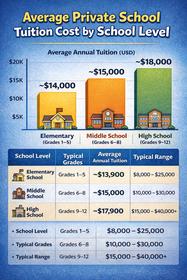
Private school tuition continues to rise steadily. According to national averages compiled by Private School Review, the typical annual cost is:

  • Elementary schools: $7,000 to $15,000
  • High schools: $12,000 to $30,000+
  • Elite boarding or independent schools: $50,000+

Additional expenses may include:

  • Uniforms and supplies
  • Transportation
. . .read more

Hidden Private School Costs Parents Miss

Updated
|
Hidden Private School Costs Parents Miss
Discover hidden private school costs parents often overlook, from fees to travel, and learn how to budget effectively in 2026.

For many families, the decision to enroll a child in private school is driven by academic quality, smaller class sizes, and specialized programs. Tuition is typically the most visible expense, and for good reason, it can range from several thousand to over $50,000 annually. However, the true cost of private education extends well beyond tuition.

Understanding hidden private school costs is essential for making an informed financial decision. In 2026, as schools expand programming and operational costs rise, these additional expenses have become more significant and, in some cases, less transparent.

This guide breaks down the most commonly overlooked costs, explains why they matter, and offers practical strategies for budgeting effectively.

Why Hidden Private School Costs Add Up

Private schools often operate with greater autonomy than public schools, allowing them to offer enriched experiences. However, that flexibility can also mean a broader range of fees and optional expenses.

According to the National Center for Education Statistics, private school enrollment remains steady, but average costs continue to rise annually. Many schools now itemize fewer expenses upfront, instead presenting them throughout the school year.

The result is a financial gap between expected and actual costs that can catch families off guard.

Common Hidden Private School Costs

1. Enrollment and Annual Fees

Before classes even begin, families often encounter multiple administrative charges.

These may include:

  • Application fees
  • Testing or assessment fees
  • Enrollment or matriculation fees
  • Annual re-enrollment fees

While individually modest, these costs can total several hundred to

. . .read more

How Middle‑Income Families Are Affording Private School in 2026

Updated
|
How Middle‑Income Families Are Affording Private School in 2026
Discover how middle‑income families are affording private school tuition in 2026 with scholarships, budgeting, financial planning, and emerging support strategies.

For decades, private school tuition has been out of reach for many middle‑income families. As costs have risen, so have concerns about equity and access. But in 2026, a combination of strategic financial planning, expanded aid programs, policy innovations, and community‑based solutions are helping more families bridge the affordability gap.

This article explores how middle‑income households are navigating private school costs today, with practical insights, trends, and expert perspectives designed for parents, educators, and students considering or currently enrolled in private education.

The Middle‑Income Squeeze: Tuition vs. Household Budgets

Private school tuition continues to climb. The National Center for Education Statistics (NCES) reports that average tuition for private secondary schools in the United States has grown faster than median household income over the past decade. While numbers vary by region and school type, annual tuition for day schools frequently exceeds $15,000, and many independent schools charge $30,000 or more. Boarding tuition often surpasses $50,000 per year.

For families earning between $60,000 and $150,000 annually — often defined as “middle‑income” — these figures create a tension between educational aspirations and financial realities.

Key financial pressures include:

  • Housing costs eating into take‑home pay
  • Student loan debt affecting borrowing capacity
  • Healthcare and childcare expenses reducing discretionary income
  • Inflationary pressures on everyday living costs

Despite these pressures, trends in 2026 show that middle‑income families are finding ways to make private education work without jeopardizing long‑term financial security.

Expanded Financial Aid and Income‑Based Tuition

One of the most significant shifts in the

. . .read more

Recent Articles

How Private Schools Are Preventing Student Burnout
Discover how private schools are addressing student burnout through wellness programs, balanced academics, and expanded mental health support.
How Private Schools Evaluate “Soft Skills” Like Leadership and Grit
Learn how private schools assess leadership, grit, resilience, and character, and why these soft skills are becoming increasingly important in admissions.
How Private Schools Handle Cell Phones: Why Phone-Free Campuses Are Growing
Discover how private schools manage cell phones, why phone-free campuses are growing, and how reduced social media access can benefit students.

Funding the Future

TUITION AND COSTS
This subcategory explores the various aspects of private school tuition, including cost variations, reasons for price differences, and what parents can expect to pay for private education.
FINANCIAL AID AND SCHOLARSHIPS
This section covers the various forms of financial assistance available to families, including scholarships, grants, and the process of applying for and receiving financial aid.
PAYMENT STRATEGIES AND OPTIONS
This subcategory provides information on different ways to pay for private school education, including loans, payment plans, and other financial strategies.
LONG-TERM FINANCIAL PLANNING
This section focuses on long-term financial considerations for parents, including tax implications, savings plans, and budgeting for private school education.